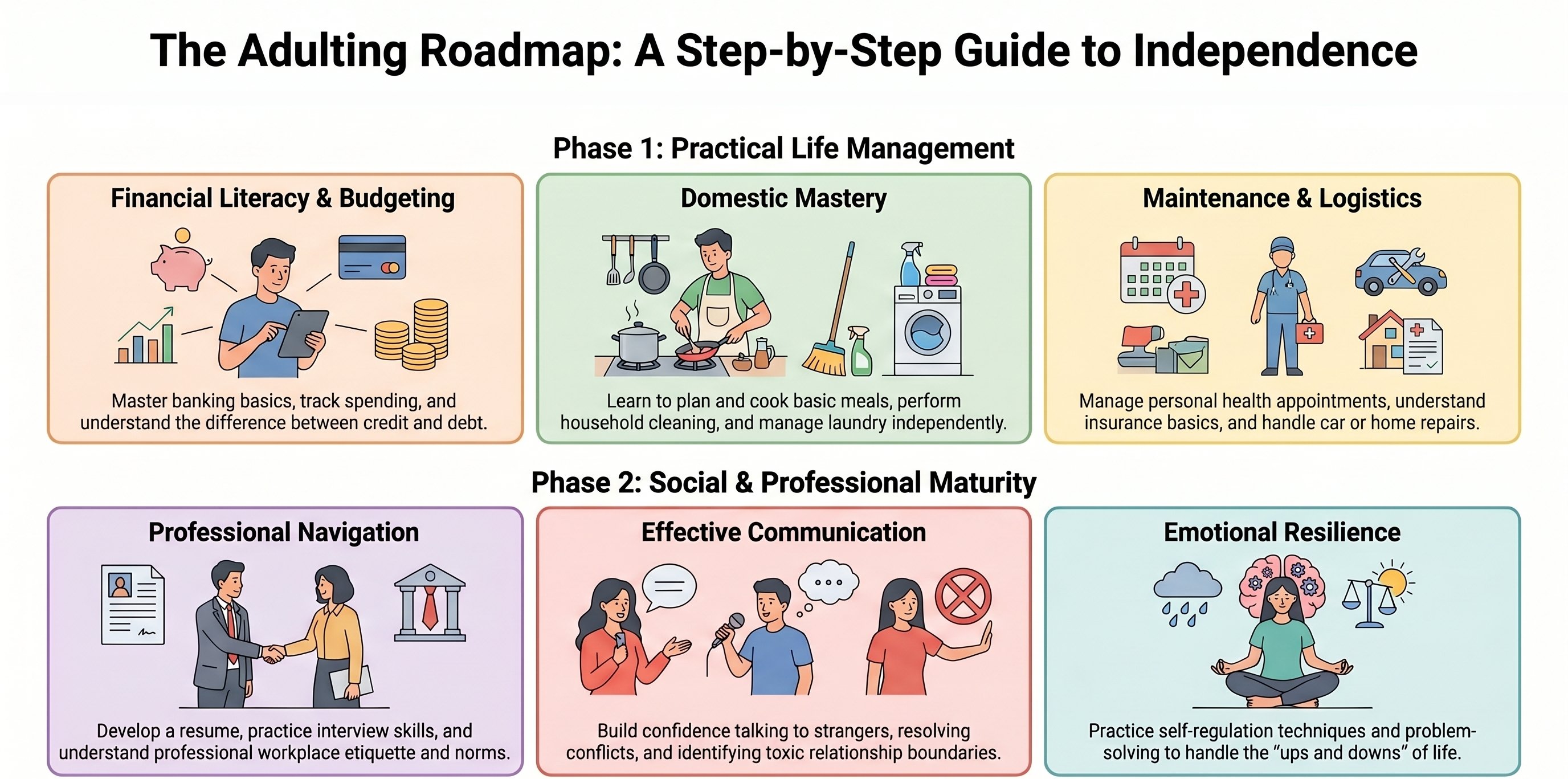
A lot of young adults arrive at this stage with an impressive resume, but suddenly realize they have absolutely no idea how to navigate basic life skills, because nobody ever formally taught them. Here at The Good Dad Co., we believe that everyone deserves the practical wisdom, steady guidance, and judgment-free help of a great dad. We are here to hand over the playbook. This is your definitive, no-nonsense guide to adulting in Austin, packed with specific advice you can actually use today.
"Everyone deserves the practical wisdom, steady guidance, and judgment-free help of a great dad."
The Good Dad Co. · Austin, TX1. Financial Literacy
You are silently terrified that one unexpected expense will completely drain your bank account, but you are too embarrassed to admit you do not know how to track your spending.
Start by practicing the 50/30/20 rule of budgeting: allocate 50% of your income to necessities, 30% to wants, and 20% to savings. If credit cards scare you or you have been relying on them too heavily, switch to a debit card so you are only spending the money you actually have.
Read up on the difference between good debt and bad debt, and start monitoring your credit report now so you can build healthy credit habits early on. You got this!
Auto Fundamentals2. Car Basics
You have been driving around with a weird dashboard light on for three weeks because going to a mechanic feels like walking into an expensive trap.
Start with the basics you can check yourself in your own driveway. To find your proper tire pressure, look at the sticker inside your driver's side door jamb, not the number stamped on the side of the tire. To check your oil, pull out the dipstick, wipe it clean with a rag, reinsert it all the way, then pull it out again: the oil level should sit between the "low" and "full" marks.
If you ever get a flat, use your body weight to crack the lug nuts loose before you jack the car up. Once the tire is off the ground, the wheel just spins when you try to loosen them. And for that mystery dashboard light: stop by an AutoZone and ask them to run a free OBD-II scan. It takes five minutes and costs nothing.
Home & AC3. Home Maintenance & Summer AC Management
You are pretty sure the dust blowing out of your vents and the dripping sink are not normal, but you are afraid asking for help will make you look completely clueless.
To survive the brutal Texas summer, you absolutely must change your HVAC air filter regularly. In most of the country, that means every 90 days. In Austin? Every 30 to 60 days, because of the dust, allergens, and the fact that your AC runs almost constantly from May through October. A clogged filter makes your unit work harder, drives up your energy bill, and shortens the life of the system.
Know exactly where your circuit breaker is located before you need it. Learn to turn off the water supply valves under your sinks and behind your toilet so that a slow drip does not become a flooded bathroom. Keep a plunger next to every toilet: create a tight seal over the drain and pump steadily until the clog clears. If you are renting, call your property manager for anything that seems structural. That is what your lease and their maintenance team are for.
Renting in Austin4. Lease Negotiation & Adulting 101
You just signed a 20-page rental agreement without understanding a single paragraph, and now you are worried you signed your life away.
Never sign a lease until you have read and understood every clause. Austin's rental market has shifted significantly since the 2021-2023 boom: vacancy rates are higher now, which means you have more leverage than you think. Ask about move-in specials, request that small repairs be completed before you sign, and always get any verbal promises in writing as an addendum to the lease.
Practice self-advocacy: look your landlord in the eye, ask clarifying questions, and respectfully push back on any clause that seems unfair. Before you hand over a deposit, confirm exactly how to set up your utilities (Austin Energy, Austin Water, and internet are the three to handle first), and do not skip renter's insurance. It typically costs $15 to $20 a month and covers you if your belongings are stolen, if a pipe floods your stuff, or if a guest gets injured in your unit.
Kitchen Confidence5. Cooking Fundamentals
You are secretly living on delivery apps and frozen pizza because boiling water feels like a high-stakes science experiment.
You do not need to be a gourmet chef, but cooking from scratch builds real independence and keeps you from bleeding cash. Start small: upgrade a package of instant ramen into a real meal by adding fresh vegetables to the boiling water and finishing it with a fried egg on top. Master a few staples: quesadillas in a cast iron pan, scrambled eggs cooked slowly over medium-low heat (lower than you think, and a lot of stirring), and a simple roasted chicken.
For the chicken: preheat your oven to 425°F, season the bird generously with salt, pepper, and olive oil, then roast it for about 90 minutes. Add potatoes, carrots, and celery to the pan and you have a full balanced meal from one dish. The leftovers last for days. In the Texas summer, when your kitchen already hits 85 degrees, a sheet pan dinner or slow cooker recipe keeps the stove off and the AC bill manageable.
Texas Yard Survival6. Drought-Aware Lawn Care & Texas Yard Maintenance
You decided to rent a house instead of an apartment. Great choice, but there is a lot more to look after. Your yard is starting to look like a crunchy brown wasteland and you have no idea how to keep things alive without running up a massive water bill.
Watch your mail for a letter from Austin Water about an "unusual spike in usage." That letter almost always means you have a hidden leak in your yard or sprinkler system that needs immediate attention. Left alone, a single broken sprinkler head can waste thousands of gallons and hundreds of dollars before you even notice.
Basic yard upkeep matters: pull weeds before they go to seed, adjust sagging gates so they latch properly, and check your outdoor lighting after storms. When you do run your sprinklers, confirm they are hitting grass, not pavement. For anything that looks like a bigger structural issue, document it and notify your landlord right away. You do not want to inadvertently take ownership of a problem that was already there, and that renter's insurance you took out in Section 4 is there if something goes sideways.
None of these skills are beyond you. Every single one of them is learnable, and most of them take less than an afternoon to get comfortable with. The hardest part is usually just knowing where to start and having someone willing to walk you through it without making you feel like you should have already known this stuff.
That is exactly why we built The Good Dad Co.